
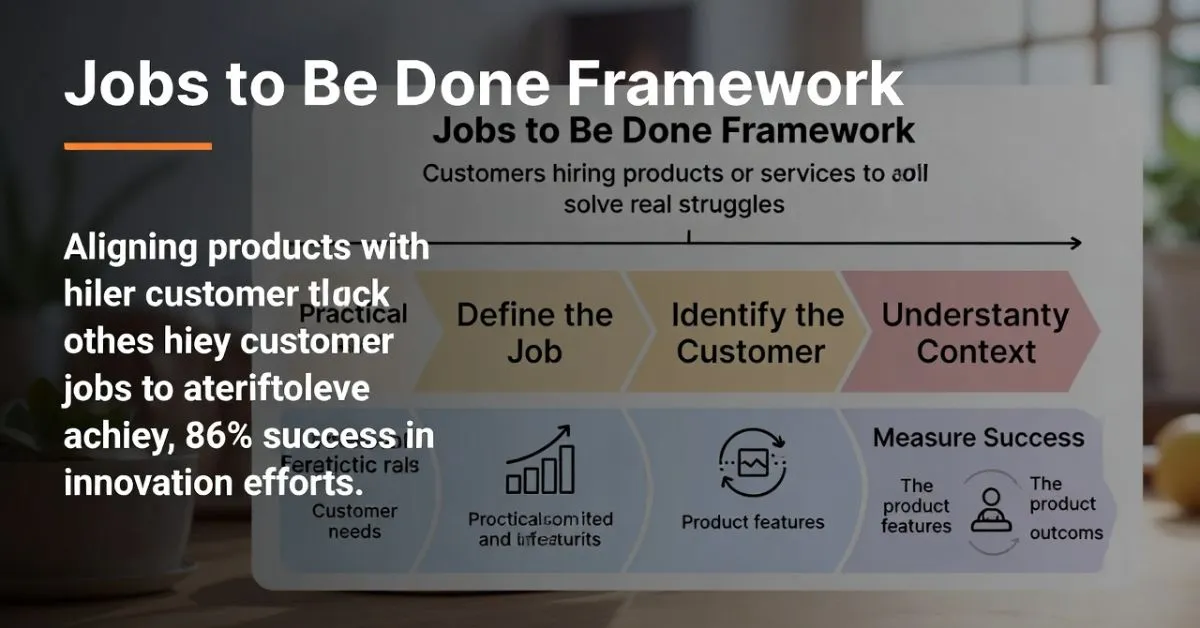
Why do people actually pick one product over another? The Jobs to Be Done framework explains it: folks “hire” things to solve a real-life struggle. Get the basics, fresh examples, easy how-to steps, and why it still rocks in 2026 (even with AI in the mix) so you can build or choose stuff that truly clicks.
Key Takeaways
- Nobody buys a drill because they want a drill—they want a hole in the wall. That’s the “job” they’re hiring for.
- This approach uncovers the practical stuff plus the feelings and social angles that surveys and personas usually skip.
- Teams that use it boost success odds big time—think 86% instead of the typical flop rate of 70-90%.
- It fits everyday choices (coffee run, app download) and today’s world (remote teams, AI helpers).
- Easiest start: chat with one person who just switched to something similar. You’ll learn more than ten feature-request surveys.
What Exactly Is the Jobs to Be Done Framework?
Let me paint a quick picture. It’s 7 a.m., you’re bleary-eyed, and you swing through a drive-thru for a giant milkshake. Weird breakfast? Maybe. But years back, a fast-food chain was scratching its head over low morning shake sales. They finally asked buyers what was really going on.
Most weren’t craving dairy. They were facing a dull, hour-long commute and needed something to sip slowly, stay full, keep their hands free, and fight boredom—no messy crumbs, no wrapper noise. The shake was basically a boredom-buster and energy buddy for the road.
Clayton Christensen told that story and it flipped how smart companies think. The Jobs to Be Done framework (or JTBD for short) says people “hire” products or services to get a job done—some progress they want in a tricky moment. Nail the job better than the competition? They keep you. Fall short? They fire you and move on.
Tony Ulwick kicked off the practical side in the ’90s with his Outcome-Driven Innovation ideas, and Christensen made it famous. Forget age brackets or income levels. Focus on the struggle happening right then. That’s why tons of “feature-packed” launches crash— they solve the wrong problem.
The Different Kinds of Jobs to Be Done Framework People Are Trying to Get Done
Jobs aren’t one-note. There’s the obvious task, but underneath sit feelings and what others think.
- Functional jobs: the straight-up thing you need handled. “Send this report without formatting disasters” or “get across town fast.”
- Emotional jobs: the inner relief or boost. “Stop feeling scattered” or “feel like I’ve got my act together.”
- Social jobs: the outside perception. “Look dependable to my boss” or “come across as the thoughtful friend.”
Take your favorite to-do app. It checks the functional box (list tasks), but it probably keeps you coming back because it calms that nagging “I’m forgetting something” anxiety and makes you look organized in meetings. Skip the emotional or social side, and even a slick tool gets ditched.
The Core Pieces That Make JTBD Click
A handful of ideas glue everything together.
Start with forces of progress. Something pushes you (this current setup sucks), something pulls you (that new thing looks promising), then anxiety or habit yanks you back. Spot those forces and you understand why even awesome ideas spread slowly.
Job mapping comes next. Slice the job into steps: setup, execution, wrap-up. For that commute job: wake grumpy, hunt for breakfast, drive half-asleep, arrive foggy. Every spot is a chance to improve.
Then write crisp outcome statements. Instead of “better focus,” try “cut the minutes until I feel sharp and ready.” Those clear targets beat fuzzy feature wish lists every time.
Some Real-Life Examples That Bring It Home
The milkshake tale is gold. Commuters hired it for distraction and sustenance on wheels. The chain responded: thicker texture for longer sipping, fruit bits for variety, cup shaped for cup holders. Boom—sales climbed.
Look around today. Streaming apps aren’t just video libraries. People hire them to “unwind and forget the day sucked.” Easy queues, mood-based picks, and no-effort watching win the day.
Note-taking tools? They grab “jot ideas before they vanish,” but the keeper is “feel less overwhelmed by my brain dump.” Quick search, clean sync, gentle reminders seal it.
Work chat apps tackle “keep the team looped in without pinging every five minutes.” Read receipts, threaded replies, away statuses hit functional and emotional notes at once.
Even a cordless drill gets hired for “build that shelf safely and fast” plus “feel handy and proud.” Brands that map the full job deliver tweaks that matter.
How to Actually Use JTBD When Building Stuff
Want to put this to work? Keep it straightforward.
- Pick a clear situation—where people switch tools or complain a lot. Skip vague stuff like “productivity.”
- Talk to real people about their last hire or fire. Ask: What led up to it? What felt wrong? What were you hoping for? No “what features do you want?”—that leads to laundry lists.
- Map the steps and outcomes. Rate what’s super important and currently frustrating. Those gaps are gold.
- Brainstorm fixes that crush the weak spots. Build quick versions, test if the job feels easier.
Interview pro tip: Stick to stories. “Walk me through the day you decided to try the new app” gets honesty. Keep chats casual, 20-30 minutes. Use a shared doc or board to sort notes so nothing gets lost.
How JTBD Stacks Up Against Other Ways of Thinking
Personas are handy for ads—they describe “Marketing Sarah, 32, coffee addict.” But they don’t explain why Sarah picks one CRM over another on a stressful Tuesday. JTBD zooms in on the moment, so decisions get sharper.
Design thinking loves empathy maps and rapid prototypes. Pair them: use jobs to decide what to empathize about, then prototype solutions. They play nice together.
Old-school surveys ask “rate these features.” JTBD asks “what outcome are you chasing?”—fewer misses, more hits.
What You Gain (and the Tricky Parts)
The wins are solid. Most new ideas tank—70-90% failure rate. JTBD crews hit closer to 86% because they chase real progress. Customers stick around longer, teams stop building unused bells and whistles.
But it’s not effortless. Good interviews need practice; beginners hear “add dark mode” instead of the deeper job. Small teams struggle to find time. Emotional and social pieces slip when everyone’s staring at spreadsheets.
Quick fixes: Begin with just five conversations. Practice neutral questions. Mix in short polls for outcome ratings. In speedy environments, zero in on one high-impact job first—no need for a massive study.
Where JTBD Is Heading in 2026 and Beyond
This isn’t frozen in time. AI is creating brand-new jobs: “keep my skills current without endless courses” or “handle repetitive grunt work so I can think bigger.” Tools that ease the fear of being replaced while delivering speed win big.
Hybrid work spun up jobs like “feel connected to colleagues even when we’re miles apart” or “hand off tasks across time zones smoothly.” The apps that reduce isolation and friction pull ahead.
Startups grab lightweight versions—fast chats, one-page maps—to test ideas without burning cash. In B2B land, it cracks open why committees say yes or no beyond spec sheets.
FAQs On Jobs to Be Done Framework
What is the jobs to be done framework?
It’s a simple lens: customers hire products to make progress on a specific struggle in their life, not because of cool features or demographics. By focusing there, teams build things that actually help and see way better results.
What are the main types of jobs in JTBD?
Functional = the practical task (e.g., track expenses). Emotional = inner feelings (e.g., reduce worry). Social = how you appear to others (e.g., look competent). All three usually play a role in why someone chooses or ditches something.
Is the jobs to be done framework outdated?
Nope—it’s adapting fast. AI and remote life create fresh jobs around learning curves and connection. The core idea (hire for progress) stays sharp and useful no matter the tech wave.
How do you conduct JTBD interviews?
Chat about a recent switch or frustration. Get the timeline: what sparked it, what held back, what success looked like. Skip feature wish lists—stories reveal the real job. Five to ten solid talks kick things off nicely.
What is an example of jobs to be done?
Commuters hired thick milkshakes to kill boredom and stay energized on long drives—no mess, one hand free, slow to finish. Not a dessert craving; a commute companion. That insight shaped tastier, car-friendly versions.
How does JTBD differ from personas?
Personas profile people (age, habits). JTBD profiles situations and the progress needed then and there. It shows why the same person picks differently depending on context—more accurate for real decisions. (278 characters)
Next time you’re picking software, designing a feature, or even shopping for yourself, pause and ask: What’s the job I’m really hiring this thing for? Grab one quick conversation with someone in the same boat. Listen hard. You’ll spot the hidden wins—and probably make way better calls.
